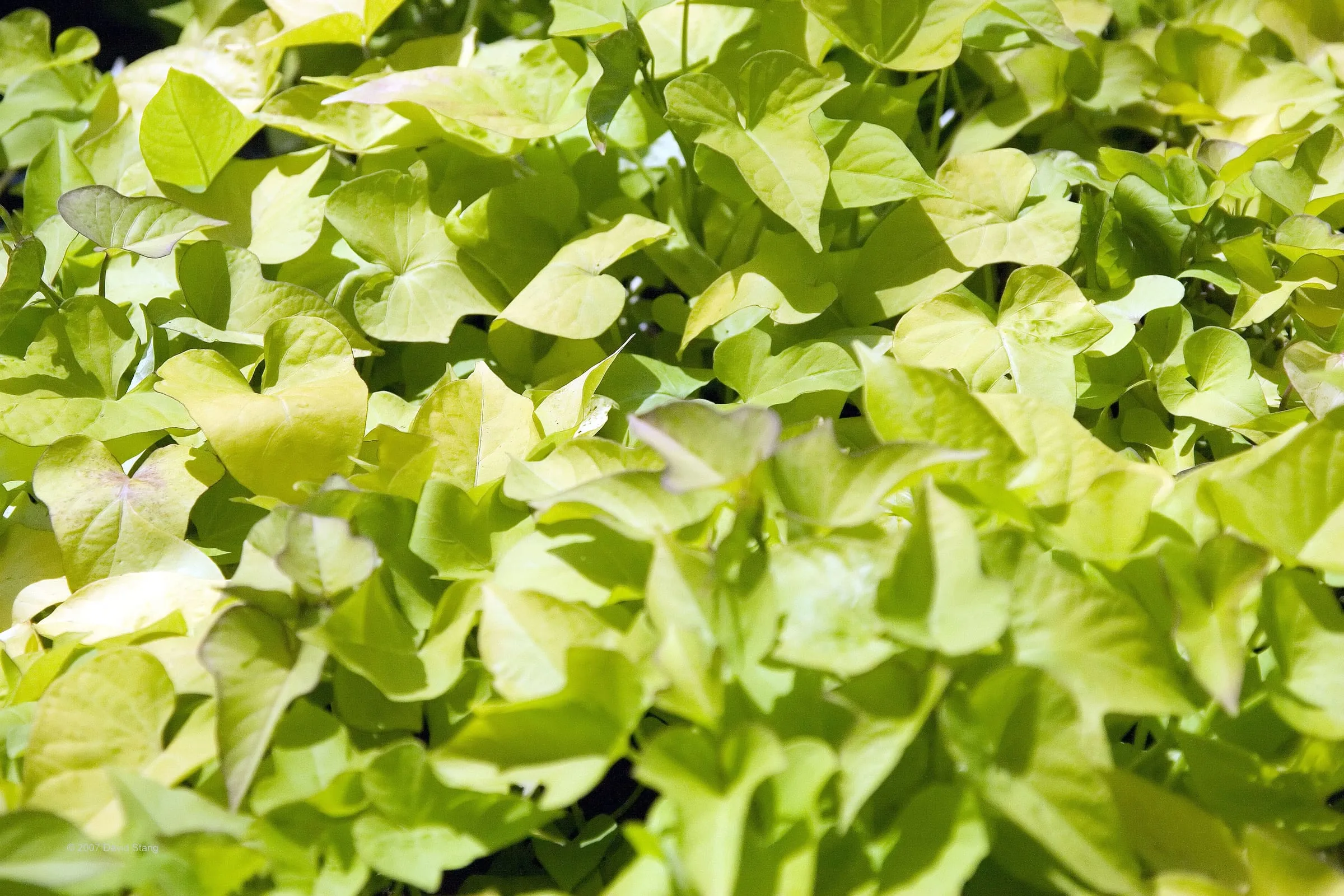
Photo: David J. Stang, CC BY-SA 4.0, via Wikimedia Commons
- Light
- full sun to part sun. The chartreuse kinds hold their color best with some afternoon shade, the dark kinds want full sun
- Water
- medium. It tolerates drought in the ground, but in a pot it wilts fast on a hot afternoon and wants a deep drink whenever the top inch is dry
- Toxicity
- non-toxic to dogs, cats and horses (ASPCA, Ipomoea batatas). This is the sweet potato itself, not morning glory. Other Ipomoea species are listed differently by the ASPCA, so the species matters
| Type | Warm-season annual |
|---|---|
| Sun | Full sun, part sun |
| Water | Medium |
| Size | 6 to 12 in tall, 3 to 5 ft wide |
| Plant in | mid-April to June |
| Interest | Summer, fall |
| Upstate winter | One season |
| Hardy zones | 9 to 11 |
| Use in | Containers, beds |
| Role | Trailer |
Toxicity confirmed against ASPCA Animal Poison Control.
Sweet potato vine is the fastest way to make a new planter look like it has been there all summer. Within a month the chartreuse or near-black leaves are pouring over the rim and down the side of the pot. It is the same species as the sweet potato on your Thanksgiving table, bred for leaves instead of roots, and NC State has released several of the best cultivars.
In the Upstate
It is hardy to zone 9, so here it is an annual. Frost turns it to mush overnight, and it does not want to go out until the soil has warmed, so mid-April at the earliest and May is safer. Heat and drought do not slow it down. Deer eat it, sometimes to the stem, which is worth knowing before it goes in a bed near the woods.
In a container
It is a trailer, under a foot tall and easily three to five feet long by August. That vigor is the whole point and also the problem: it will swallow a calibrachoa or a small geranium if you let it. Cut it back hard, by a third or more, whenever it starts to bury its neighbors, and it grows right back. A pot in full sun may need water daily in July. It does not need swapping midseason.
Care
Water when the top inch is dry, feed lightly, and trim without mercy. That is the whole program. Watch for flea beetles chewing small holes in the leaves. The one thing that kills it is cold: a spring cold snap after an early planting, or the first fall frost, and it is done.
Want this planted for the light you actually have? Start a project
Where it shows up
Sources
- NC State Extension Plant Toolbox, Ipomoea batatas (plants.ces.ncsu.edu/plants/ipomoea-batatas/)
- Clemson HGIC 1152, Growing Annuals (hgic.clemson.edu/factsheet/growing-annuals/)
- ASPCA, Sweet Potato Vine (aspca.org)