Photo: Cillas, CC BY-SA 4.0, via Wikimedia Commons
- Light
- full sun, six hours or more. In shade it flowers less and flops
- Water
- low to medium. Water deeply when the top inch is dry; steady moisture in summer is what buys a second flush of bloom
- Toxicity
- not listed by ASPCA or Pet Poison Helpline. The ASPCA's sage entries cover culinary sage (Salvia officinalis), a different species, and say nothing about this plant. Absence from the lists is not evidence of safety
| Type | Perennial |
|---|---|
| Sun | Full sun |
| Water | Low |
| Size | 18 to 24 in tall, 12 to 18 in wide |
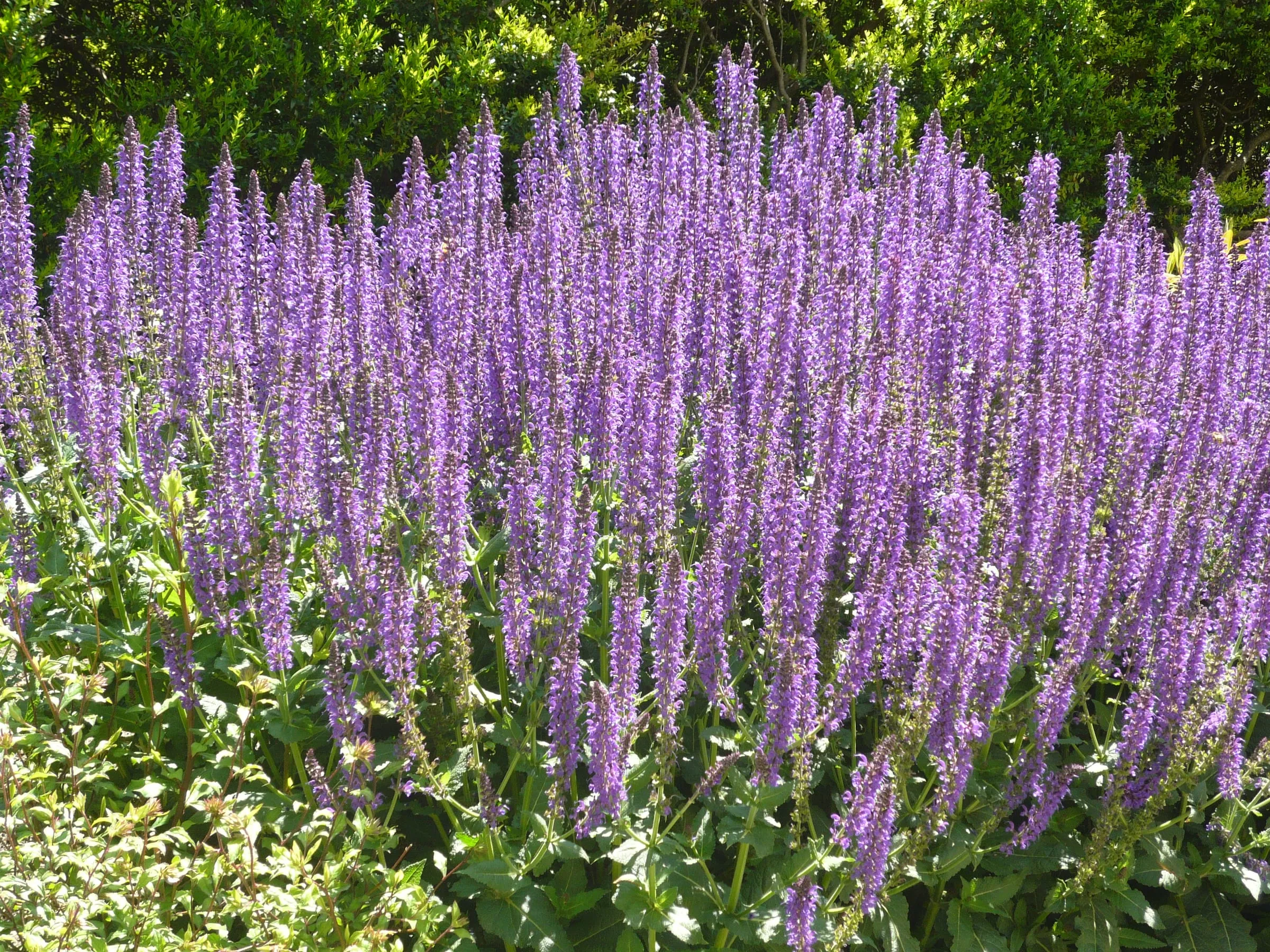
| Bloom | deep violet-blue · May to June, with repeat flushes into fall if cut back |
| Plant in | April, after the last frost |
| Interest | Spring, summer |
| Upstate winter | Survives our winter |
| Hardy zones | 4 to 8 |
| Use in | Containers, beds |
| Role | Filler, height |
Toxicity not independently confirmed: Not listed by ASPCA or Pet Poison Helpline. If you have pets, check with the ASPCA or your vet before putting this one where they can reach it.
‘May Night’ is the perennial salvia with the darkest violet-blue spikes, on a compact plant about 18 to 24 inches tall. It blooms in May when the spring pansies are finishing and the summer annuals are barely in, which is exactly the gap that needs filling. Bees and hummingbirds work it, deer and rabbits leave it alone, and the crushed leaves smell of sage. Clemson calls this group the hardy salvia for the upper Piedmont, and Greenville is the upper Piedmont.
In the Upstate
It is hardy well below anything our winters do, in the ground or in a pot, and Clemson’s timing is spring planting after the last frost, so mid-April here. This plant likes cool nights, and by July in Greenville the stems open up and flop. That is normal. Cut it back to the basal leaves when it looks tired and it regrows, and if you keep the soil evenly moist it will send up more spikes into fall. Leave the dead stems on over winter and prune in early spring once new growth shows, which protects the crown from a late freeze.
In a container
In a planter it is a filler with a little height, in front of a taller grass or a small shrub, and its spikes read well against yellow or silver. It stays 18 to 24 inches and 12 to 18 inches wide. Water when the top inch of mix is dry, which in a July pot may be every other day. It does not need swapping out, but plan on cutting it back hard once in midsummer and letting it refill.
Care
Water deeply and let the surface dry between drinks. It grows fine without feeding in decent soil, and too much water and fertilizer bring on fungal problems and rot. Cut spent spikes promptly and it reblooms. The one thing that kills it is a pot or bed that stays wet, especially in winter. Give it sun and drainage and it is one of the easier perennials to grow here.
Want this planted for the light you actually have? Start a project
Sources
- Clemson HGIC 1174, Salvia (hgic.clemson.edu/factsheet/salvia/)
- NC State Extension Plant Toolbox, Salvia x sylvestris and Salvia nemorosa (plants.ces.ncsu.edu)
- Missouri Botanical Garden Plant Finder, Salvia x sylvestris 'Mainacht' (missouribotanicalgarden.org)
- ASPCA toxic and non-toxic plant list, searched for Salvia nemorosa and Salvia x sylvestris, no entry (aspca.org)