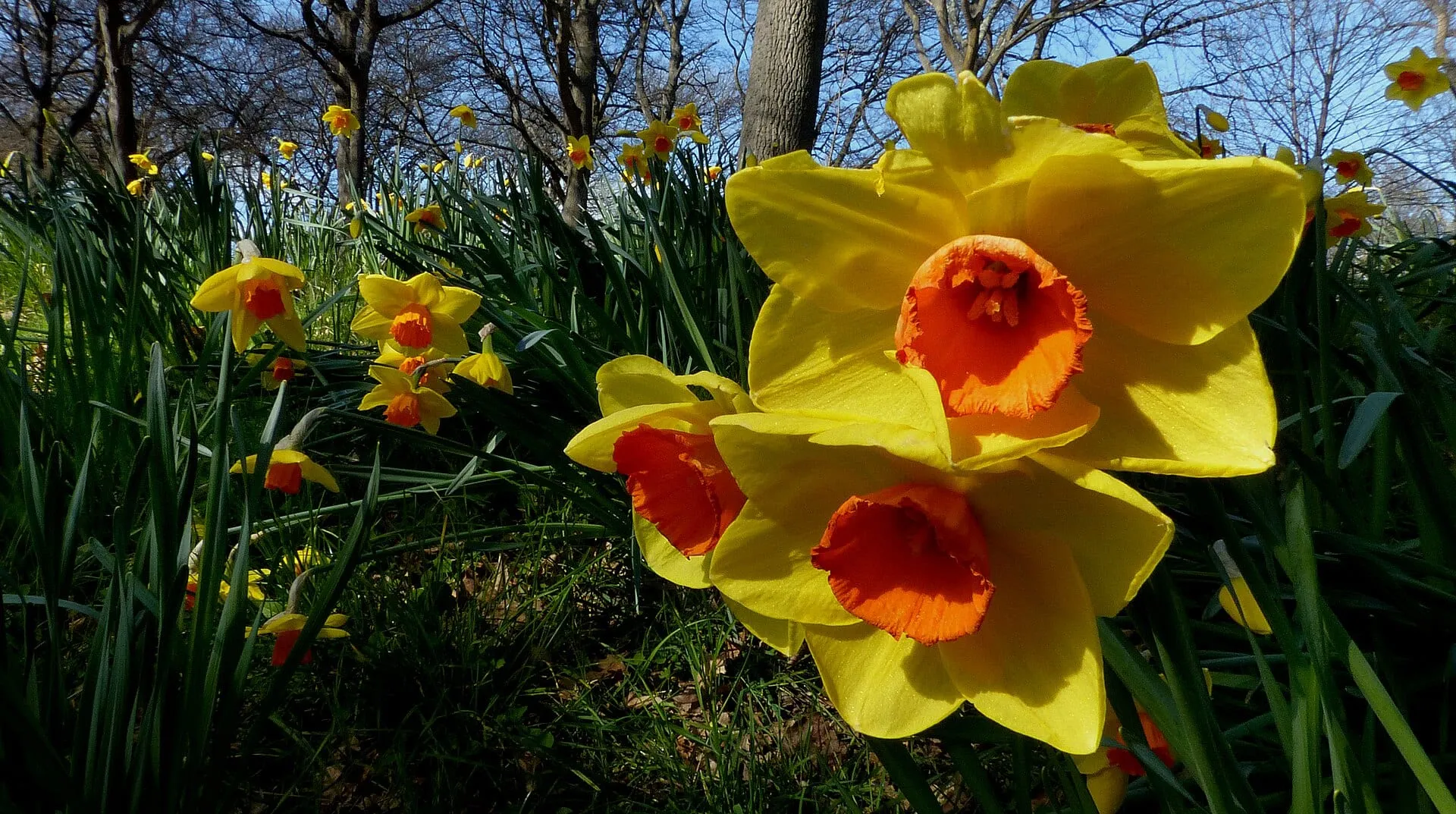
Photo: Bernard Spragg. NZ, CC0, via Wikimedia Commons
- Light
- full sun to part shade while in leaf, at least six hours. Under a deciduous tree works, because the bulb finishes before the canopy fills in
- Water
- low. Normal rain is enough in the ground. Water a dry spring to stretch the bloom, and keep a pot moist but never soggy
- Toxicity
- toxic to dogs, cats and horses (ASPCA, Narcissus spp., a genus-level entry): lycorine and other alkaloids; vomiting, salivation, diarrhea; large ingestions cause convulsions, low blood pressure, tremors and cardiac arrhythmias; the bulbs are the most poisonous part. Also poisonous to people (NC State Extension, medium severity): toxic if large quantities are eaten (nausea, vomiting, diarrhea, convulsions), and handling bulbs, flowers and stems can cause a severe skin rash
| Type | Bulb |
|---|---|
| Sun | Full sun, part sun |
| Water | Low |
| Size | 8 to 30 in tall, 6 to 12 in wide |
| Bloom | yellow, white, orange, pink · late winter to spring, roughly February to April depending on the cultivar |
| Plant in | October to November |
| Interest | Winter, spring |
| Upstate winter | Survives our winter |
| Hardy zones | 4 to 8 |
| Use in | Containers, beds |
| Role | Filler |
Toxicity confirmed against ASPCA Animal Poison Control; NC State Extension Plant Toolbox.
Daffodils are the spring bulb that actually comes back in the South. Clemson calls them the most successful of the popular bulbs for naturalizing here: unlike tulips they bloom year after year, they multiply, deer and rabbits ignore them, and the animals that dig up tulip bulbs in winter rarely touch a daffodil. Some bloom as early as January. Plant them in fall under the pansies so a winter pot has a second act, and tuck them into beds where the leaves can ripen out of sight.
In the Upstate
They are hardy through our winters and need a cold period to bloom, which Greenville supplies without any help. Clemson’s timing is to buy in September or October and plant in October or November, 6 to 8 inches deep, in well-drained soil that gets at least six hours of sun while the leaves are up. There are two catches. First, many big trumpet and double cultivars do not repeat in our warm climate, so choose from the jonquil, tazetta, poeticus and species groups, or from Clemson’s reliable large-flowered list, such as ‘Ice Follies’, ‘Carlton’ and ‘Mount Hood’, or a miniature such as ‘Tete-a-Tete’. Second, the leaves must stay on for at least six weeks after bloom, yellowing and flopping, or next year’s flowers do not form.
In a container
Bulbs go in a fall pot as the surprise under pansies and violas, 8 to 30 inches tall depending on the cultivar, with a miniature such as ‘Tete-a-Tete’ the neatest fit. Plant them in October, leave the pot outdoors so the bulbs get their chill, and keep the mix moist but not wet. After bloom, treat a pot of daffodils as a one-season show: let the foliage ripen, then plant the bulbs out in a bed. Clemson’s note on forced bulbs applies here too: a daffodil that bloomed in a pot may skip a year before it flowers again in the ground.
Care
Water only in a dry spring. Skip fertilizer on a one-season planting, while permanent beds get a slow-release fertilizer at planting and again when shoots emerge. Snap off spent flowers so the plant does not make seed, but leave the leaves alone until they brown, and divide crowded clumps every three or four years after the foliage dies down. The one thing that kills a daffodil is a wet bed or a saucer full of water, which rots the bulb. The one thing that kills next year’s bloom is cutting the leaves too soon.
Want this planted for the light you actually have? Start a project
Sources
- Clemson HGIC 1155, Spring-Flowering Bulbs (hgic.clemson.edu/factsheet/spring-flowering-bulbs/)
- Clemson HGIC 1556, Forcing Bulbs Indoors (hgic.clemson.edu/factsheet/forcing-bulbs-indoors/)
- Clemson HGIC, Dependable Daffodils for Heavy Soils in South Carolina (hgic.clemson.edu)
- NC State Extension Plant Toolbox, Narcissus (plants.ces.ncsu.edu)
- Missouri Botanical Garden Plant Finder, Narcissus (missouribotanicalgarden.org)
- ASPCA, Daffodil (aspca.org)