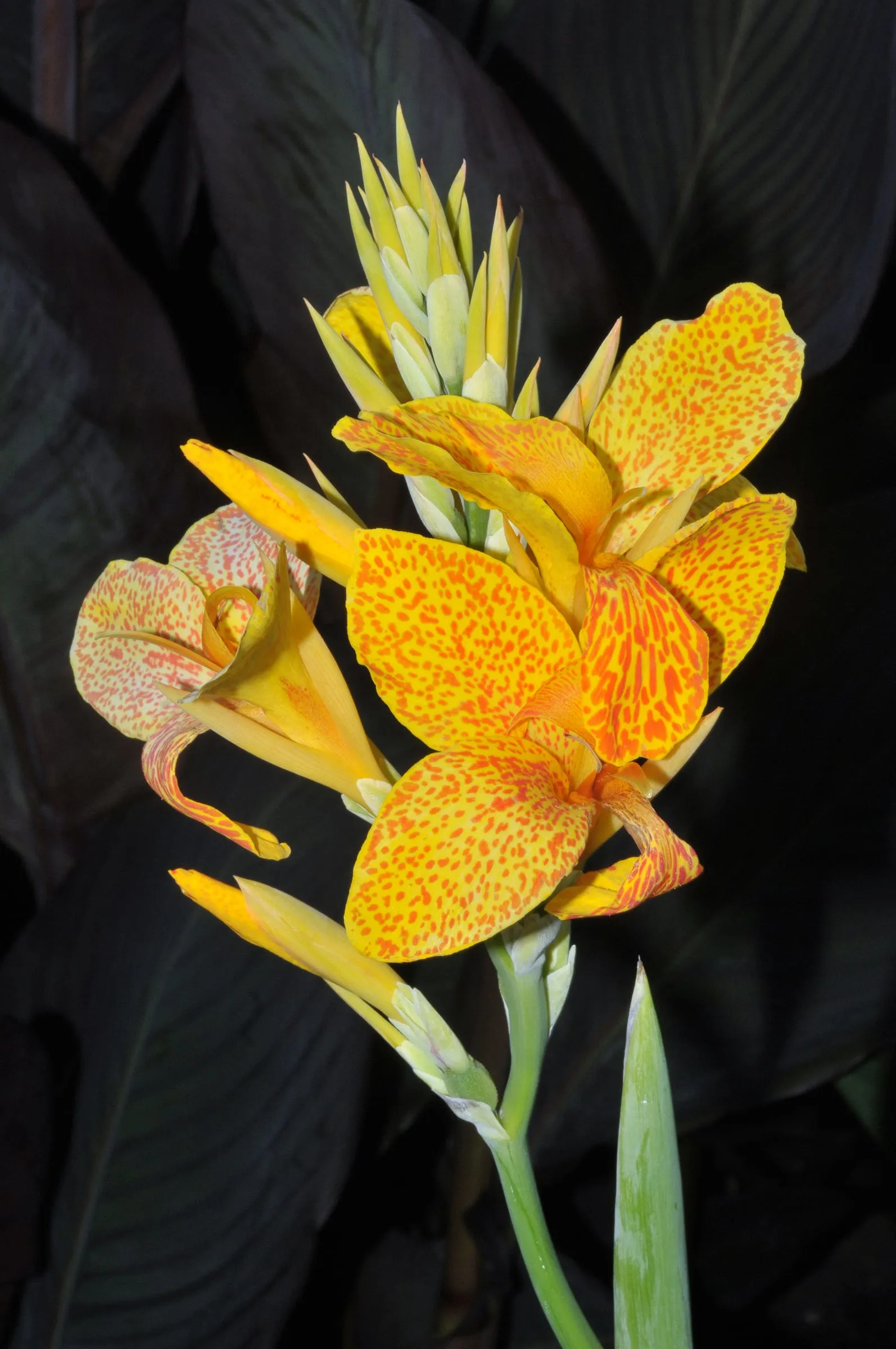
Photo: Michael Gäbler, CC BY 3.0, via Wikimedia Commons
- Light
- full sun to part shade. Fewer flowers in shade, but the foliage still earns its place
- Water
- medium to high. Keep it moist; it takes wet feet far better than dry ones, and a big pot in July may want water daily
- Toxicity
- non-toxic to dogs, cats and horses (ASPCA, listed as canna lily, Canna generalis)
| Type | Bulb |
|---|---|
| Sun | Full sun, part sun |
| Water | High |
| Size | 2 to 6 ft by cultivar, dwarfs 20 to 36 in tall, 1 to 2 ft wide |
| Bloom | red, orange, yellow, pink, white · early summer to frost |
| Plant in | mid-April to June |
| Interest | Summer, fall |
| Upstate winter | Survives most winters |
| Hardy zones | 7 to 10 |
| Use in | Containers, beds |
| Role | Height |
Toxicity confirmed against ASPCA Animal Poison Control.
Canna is the fastest way to make a porch look tropical. Big paddle leaves, green or bronze or striped, come up in May and by July there are red, orange, or yellow flowers on top that hummingbirds visit all summer. Clemson says it plainly: cannas can take the heat. The dwarf cultivars, 20 to 36 inches tall, are the ones that make sense in a pot.
In the Upstate
Clemson lists cannas as hardy in zones 7 to 10, so in a Greenville bed the rhizomes overwinter under mulch and come back every spring. A pot is different: the roots see roughly one zone colder than the ground, so a container canna can freeze out in a hard winter. Plant it from mid-April once frost is past. It does nothing in cold soil. It hits its stride in July and August and blooms until frost knocks the tops down in November.
In a container
It is the height in the pot. Choose a small cultivar like the Cannasol series or ‘Tropical White’, which Clemson recommends for pots, or a mid-sized Cannova if the container is large, and give it a large container either way. Keep it moist: NC State notes cannas tolerate standing water, and a big-leaved canna in a sunny July pot may want water every day. Cut spent flower stalks and it keeps blooming. It does not need swapping mid-season. Wind shreds the leaves, so keep it off a windy corner.
Care
Water generously. Clemson suggests an all-purpose slow-release fertilizer for potted cannas at planting. Deadhead to keep flowers coming. After frost, cut the stalks to the soil. If you want to keep the rhizomes, move the pot to a garage, or dig them and store them cool and dry over winter, as NC State describes. The one thing that kills it is dry soil in August, and the second is a wet pot that freezes solid in January.
Want this planted for the light you actually have? Start a project
Where it shows up
Sources
- Clemson HGIC, Cannas Can Take the Heat! (hgic.clemson.edu/cannas-can-take-the-heat/)
- NC State Extension Plant Toolbox, Canna x generalis (plants.ces.ncsu.edu)
- ASPCA, Canna Lily (aspca.org)