Photo: Captain-tucker, CC BY-SA 3.0, via Wikimedia Commons
- Light
- full sun to part sun. Six hours gives the most flowers, and a little afternoon shade helps it through July and August
- Water
- medium. Let the top inch dry, then water well. A hanging basket in August can need it every day, but it rots if kept wet
- Toxicity
- not listed by ASPCA or Pet Poison Helpline. Absence from the list is not evidence of safety
| Type | Warm-season annual |
|---|---|
| Sun | Full sun, part sun |
| Water | Medium |
| Size | 3 to 9 in tall, 12 to 24 in wide |
| Bloom | purple, pink, red, orange, yellow, blue, white · late spring to frost |
| Plant in | mid-April to June |
| Interest | Summer, fall |
| Upstate winter | Needs protection |
| Hardy zones | 7 to 11 per NC State, but grown as an annual here |
| Use in | Containers |
| Role | Trailer, filler |
Toxicity not independently confirmed: Not listed by ASPCA or Pet Poison Helpline. If you have pets, check with the ASPCA or your vet before putting this one where they can reach it.
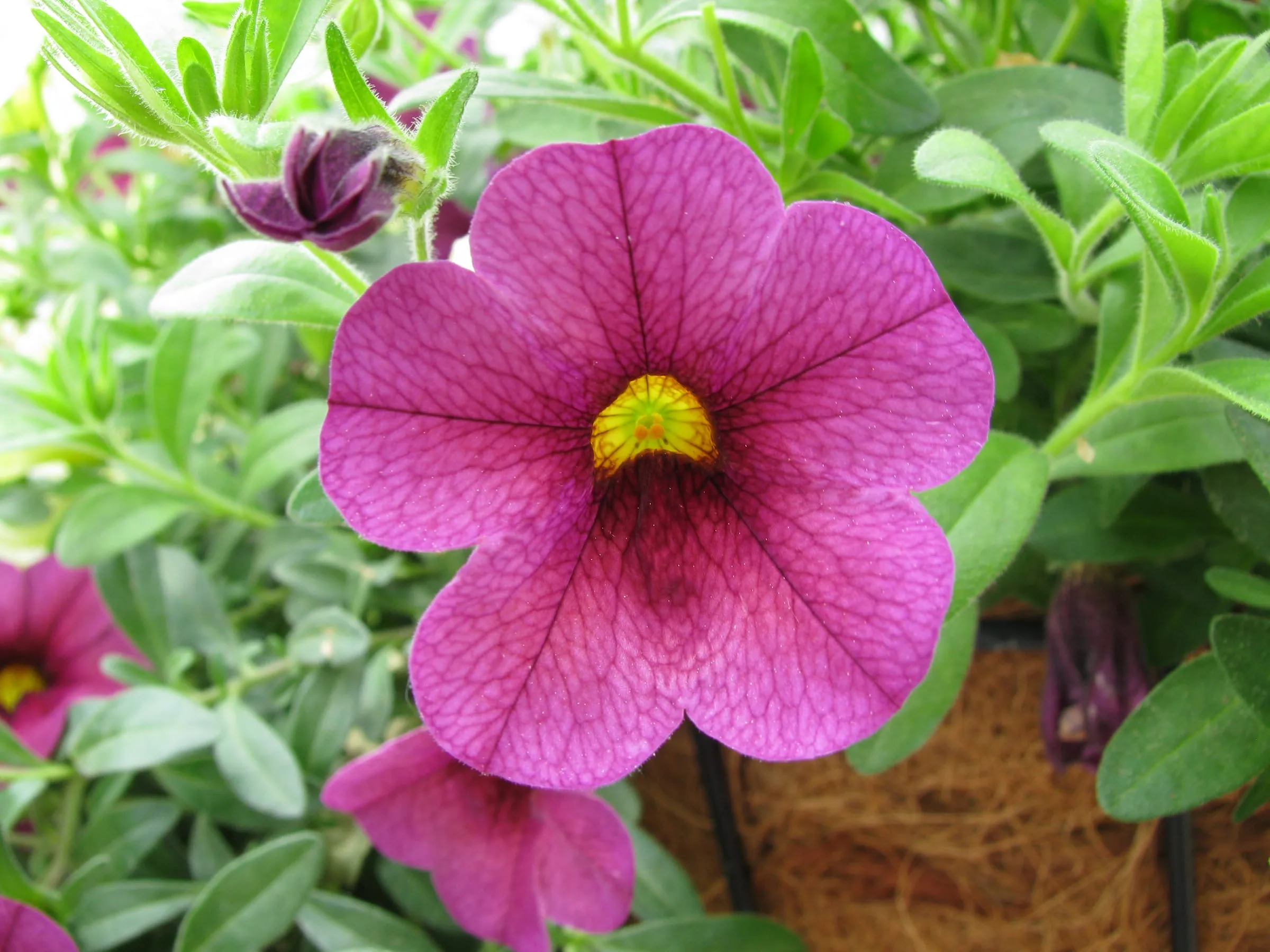
Calibrachoa looks like a petunia that went to finishing school: hundreds of inch-wide flowers, no sticky mess, and nothing to deadhead. It is a natural spiller for a sunny spring or summer planter. The colors run from soft apricot to nearly black, and the double forms look like tiny roses.
In the Upstate
NC State lists it as hardy to zone 7, and a Clemson agent has seen it winter over in the Upstate after a mild year. Still, plant it as an annual. A wet January kills the crown faster than the cold does, and in a pot the roots sit a zone colder than the ground. It goes out from mid-April, blooms hard through June, sulks a little in the worst of August, and picks back up in September until frost.
In a container
Pots and baskets are where it belongs. In a bed it wants a raised spot with sharp drainage, and our red clay is the opposite of that. Expect a plant 3 to 9 inches tall and up to two feet across, trailing 8 to 12 inches over the rim. Three or four plants fill a 12 to 14 inch basket. It does not need swapping midseason. If it gets stringy in August, pinch it back by a third and feed it.
Care
It is a hungry plant. Mix a slow-release fertilizer into the potting soil at planting, then feed with a liquid fertilizer every two to three weeks all summer, or the leaves go pale and the flowers thin out. Water when the top inch is dry and let it drain. The one thing that kills it is a saucer of standing water or a heavy mix that never dries, which brings root and stem rot.
Want this planted for the light you actually have? Start a project
Where it shows up
Sources
- Clemson HGIC, Calibrachoa (hgic.clemson.edu/calibrachoa/)
- Clemson HGIC 1152, Growing Annuals (hgic.clemson.edu/factsheet/growing-annuals/)
- NC State Extension Plant Toolbox, Calibrachoa x hybrida (plants.ces.ncsu.edu/plants/calibrachoa-x-hybrida/)
- ASPCA toxic and non-toxic plant list, searched for Calibrachoa and Million Bells (aspca.org)
- Pet Poison Helpline, searched for calibrachoa (petpoisonhelpline.com)